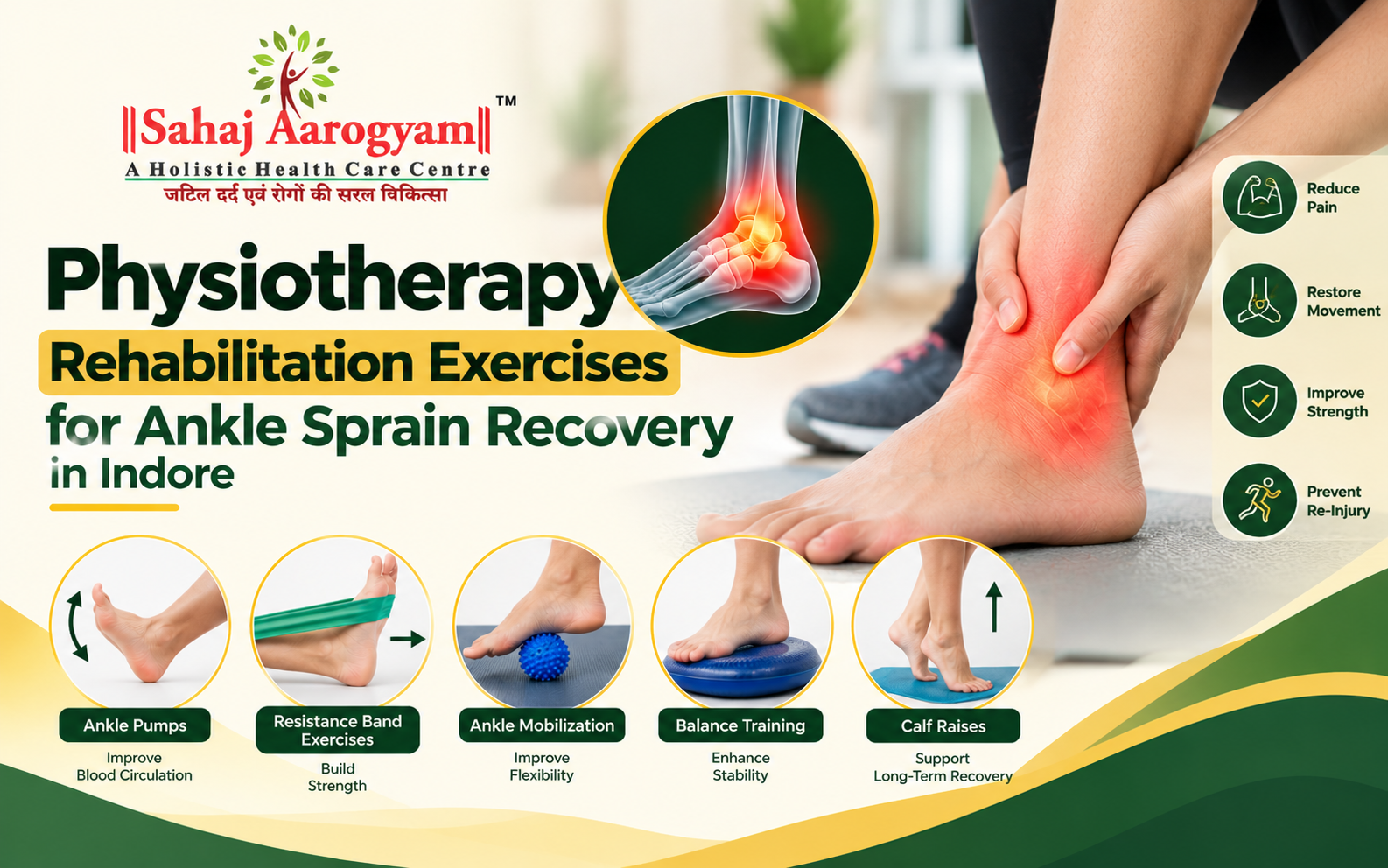
At Sahaj Aarogyam, Indore, our advanced physiotherapy services focus on supporting ankle sprain recovery, improving mobility, and helping patients gradually return to their daily activities through an appropriate rehabilitation plan.
Ankle sprain physiotherapy in Indore may be useful when rehabilitation is appropriate after an ankle injury. The right plan depends on the severity of the sprain, pain, swelling, walking ability and any other injuries. At Sahaj Aarogyam, physiotherapy and rehabilitation services can be discussed as part of an individualised recovery approach.
What Happens During an Ankle Sprain?
Ligaments connect bones and help stabilise a joint. An ankle sprain often occurs when the foot rolls or twists unexpectedly, placing excess force on these tissues. It can happen during sports, walking on uneven surfaces, stepping off a curb or missing a stair.
An ankle sprain is not the same as a fracture, and symptoms can overlap. Severe pain, inability to bear weight, obvious deformity or marked tenderness around the bones may require prompt medical evaluation. Do not assume every twisted ankle is a simple sprain.
Common Signs and Symptoms
Symptoms vary according to the injury. They may include:
· Pain around the ankle, especially when standing or walking.
· Swelling or bruising near the injured area.
· Tenderness when the ankle is touched.
· Difficulty moving the foot through its usual range.
· A feeling that the ankle is weak or unstable.
· Reduced confidence when turning or walking on uneven ground.
If you cannot take a few steps, have severe pain, notice a deformity, develop numbness or experience a cold or discoloured foot, seek prompt medical care.
Why Assessment Matters Before Exercise
An assessment helps establish whether the injury is likely to be a sprain and whether rehabilitation can begin safely. A clinician may ask how the injury happened, where the pain is located and whether you can bear weight. The assessment may consider swelling, tenderness, movement and stability when appropriate.
Fractures and other injuries may resemble sprains, so professional evaluation is important when symptoms are severe or walking is difficult. Exercise should not be used to test an injury that may need urgent care.
How Physiotherapy May Help During Recovery
Rehabilitation is usually progressed in stages, based on the injury and the person's response. Not everyone should start the same exercises on the same day.
1. Early protection and symptom management
Depending on the injury, early care may involve protecting the ankle, limiting activities that worsen pain and following clinical guidance about weight-bearing. A clinician may advise suitable support. Avoid forcing movement or returning to sport while walking remains significantly painful.
2. Restoring comfortable movement
When appropriate, gentle ankle movement can help address stiffness. The range and timing should follow advice given for the injury. If pain or swelling increases substantially, the plan may need review.
3. Strengthening supporting muscles
As the ankle tolerates more activity, rehabilitation may introduce exercises for the muscles around the ankle and lower leg. Progression should reflect pain, control and function rather than a fixed timetable.
4. Balance and stability training
After a sprain, some people experience reduced balance or a feeling that the ankle may give way. Suitable balance exercises may be included when safe. People who are unsteady should use support and avoid challenging drills without supervision.
5. Gradual return to activity
The return to normal activity should be gradual. Walking tolerance, swelling, strength, balance and the demands of the intended activity can guide progression. Sports involving jumping, rapid direction changes or uneven ground may require additional preparation.
Everyday Guidance During Recovery
Follow the instructions provided by your treating professional. General points to consider include:
· Avoid activities that cause sharp pain or make swelling noticeably worse.
· Use recommended support or walking aids correctly if advised.
· Keep walkways clear and use handrails while walking is limited.
· Do not return to running or competitive sport solely because pain has reduced.
· Seek follow-up if walking, stability or pain is not improving as expected.
Avoid copying an exercise routine from someone with a different injury. A mild sprain and a more serious ligament injury may need different levels of protection and rehabilitation.
When Should You Seek Further Medical Advice?
Arrange a clinical review if pain or swelling worsens, you cannot gradually increase walking, the ankle repeatedly gives way, or symptoms are not improving as expected. Repeated sprains can be associated with ongoing instability and may need a structured assessment.
Seek urgent care after a significant injury if you cannot bear weight, the ankle looks deformed, pain is severe, or the foot becomes numb, cold or discoloured.
Ankle Sprain Physiotherapy at Sahaj Aarogyam, Indore
An ankle injury can affect mobility, work and recreational activity. A rehabilitation plan should be based on the injury, current function and activities you want to return to. Sahaj Aarogyam offers physiotherapy and rehabilitation services in Indore. Contact the centre to discuss your symptoms and whether its services may be suitable after medical assessment.
Official website: https://www.sahajaarogyam.com/
Expert team profile: https://sahajaarogyam.com/sahaj-main/public/index.php/our-expert-team/dr-nirmal-saklecha
Google Business Profile: https://share.google/YeVYpNSmi6vLoMeJE
Frequently Asked Questions
1. Can physiotherapy help after an ankle sprain?
It may help restore movement, strength, balance and function when appropriate. A clinician should consider whether further medical assessment is needed.
2. How do I know if my ankle is sprained or fractured?
Symptoms can overlap, so you cannot always tell at home. Severe pain, bony tenderness or difficulty bearing weight may require prompt evaluation.
3. Should I walk on a sprained ankle?
Weight-bearing advice depends on the injury. Follow professional instructions and do not force walking through severe pain.
4. When can I start ankle exercises?
Timing depends on the injury. Some sprains may benefit from gentle movement, while others need protection or assessment first.
5. How long does an ankle sprain take to recover?
Recovery varies with injury severity, other injuries, activity demands and individual progress.
6. Can an ankle sprain happen without bruising?
Yes. Bruising is not present in every case, and its absence does not rule out a significant injury.
7. Why does my ankle still feel unstable?
Strength, balance or ligament-related issues may contribute. Persistent instability should be assessed.
8. Can I return to sport when the pain is gone?
Pain alone is not enough to determine readiness. Strength, balance, movement control and sport-specific demands matter too.
9. Should I use an ankle brace?
A brace may be advised for some injuries or activities, but type and duration depend on individual assessment.
10. Where can I explore ankle sprain physiotherapy in Indore?
Contact Sahaj Aarogyam to discuss rehabilitation options and whether its physiotherapy services are suitable.